
· Reading time: ~9 min · Author: Alessandro Greco
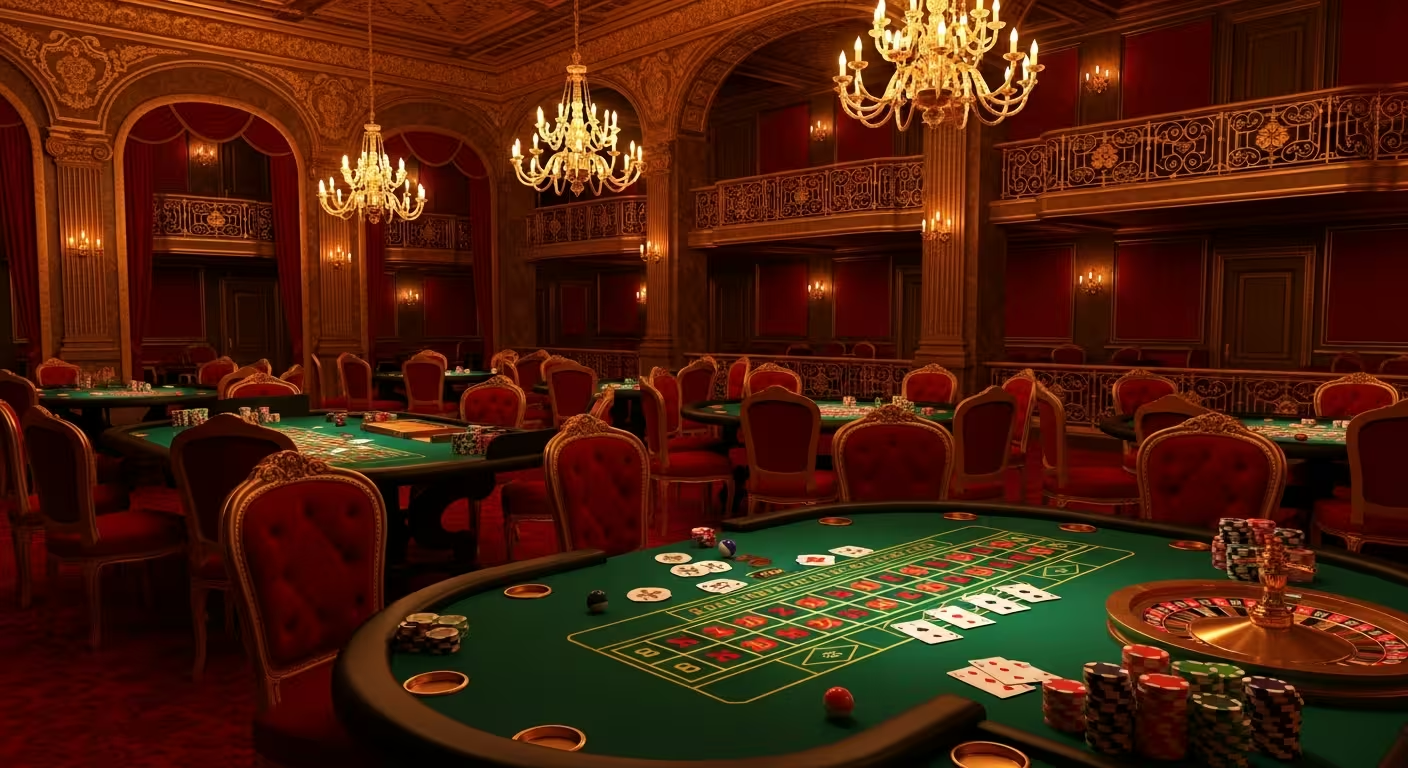
There is a red thread running through four centuries of Italian history -- and it is not politics, not religion, not even football. It is gambling. From the secret halls of Venetian palaces in the 17th century to the ultra-fast servers that today power thousands of online slots, Italy has never stopped playing. In fact, it invented the very concept of a casino. At WinWinter Casino we believe that knowing the past is the best way to understand the present -- and to play with an awareness that very few players possess. This is the true story of Italian gambling: 400 years of passion, scandals, laws and technological revolutions that have shaped the way millions of people experience gaming today.
1638: The Ridotto of Venice -- Where It All Began
The year is 1638. The Most Serene Republic of Venice is at the peak of its commercial and cultural power. Carnival lasts for months, masks conceal identities and intentions, and in the private rooms of palaces along the Grand Canal, gambling takes place with sums that would make a modern hedge fund blush. The problem? Underground gambling is uncontrollable -- brawls, debts, ruined families. The Great Council decides to do something revolutionary: instead of banning gambling, it institutionalises it.
Thus the Ridotto is born, housed in Palazzo Dandolo near the church of San Moise. It is the first public casino in the history of humankind. The rules are strict: entry only with a bauta (the Venetian mask), the games are basetta and faro, and the house retains a fixed percentage -- exactly like the house edge in modern casinos. The Ridotto will remain open for 136 years, until its closure in 1774 by order of the Doge, concerned about the economic ruin of the aristocracy. But the seed has been planted: the world has discovered that gambling can be organised, regulated and -- within certain limits -- safe.
A detail that changes the perspective: the house edge at the Venetian Ridotto was estimated at around 5-8% -- a value surprisingly similar to that of modern online slots with an RTP of 92-95%. Four centuries of technological evolution, yet the fundamental mathematics of gambling has not changed by a single decimal. The house always wins in the long run -- and the smart player knows it, accepts it and turns this awareness into a competitive advantage. Because playing does not mean always winning: it means choosing how much, where and how to risk. If you want to discover other mechanisms modern casinos prefer not to explain too openly, our guide to 10 online casino secrets reveals plenty of them.
What was the first casino in the world?
The Ridotto of Venice, opened in 1638 at Palazzo Dandolo near San Moise, is universally recognised by historians as the first public casino in history. It was created by the government of the Venetian Republic to regulate gambling during the Carnival period and limit the devastating effects of underground gambling on Venice's economy and society.
The 19th Century: The Great Ban and the Birth of Modern Casinos
After the closure of the Ridotto, gambling in Italy enters a long period of clandestinity. The Unification of Italy in 1861 brings a fragmented legislative framework -- each former state has its own rules. Public gambling is officially banned, but reality tells a different story: illegal gambling dens thrive in every city, from Naples to Milan, from Rome to Palermo. The demand for gambling is irrepressible.
The turning point comes at the dawn of the 20th century. In 1905 the Casino di Sanremo opens -- the first modern casino in Italy, still operating today. It is followed in 1917 by the Casino di Campione d'Italia, a small Italian enclave on Swiss territory, and in 1947 by the Casino de la Vallee in Saint-Vincent, in the Aosta Valley. Together with the Casino di Venezia (reopened in 1946), they form the four casinos authorised by Italian law -- the only physical places where table gambling is legal in the country.
| Casino | Year opened | City | Historical curiosity |
|---|---|---|---|
| Casino di Venezia | 1638 (reopened 1946) | Venice | The oldest in the world, housed at Ca' Vendramin Calergi |
| Casino di Sanremo | 1905 | Sanremo | Same building as the Italian Song Festival |
| Casino di Campione | 1917 | Campione d'Italia | Italian enclave in Switzerland, reopened in 2007 |
| Casino de la Vallee | 1947 | Saint-Vincent | The largest in Europe by gaming floor area |
The 20th Century: Lotteries, Totocalcio and Mass Gaming
While casinos remain a privilege of the few, the 20th century democratises Italian gambling in a way no one could have predicted. In 1932 the New Year's Lottery is born -- the first major national game that involves millions of Italians. The ticket costs little, the dream is enormous, and participation becomes a collective ritual that survives to this day.
But it is 1946 that marks the true revolution: the birth of Totocalcio. For the first time in history, gambling merges with the national sporting passion. Predicting the results on the Saturday betting slip becomes a popular obsession that unites workers and professors, north and south, men and women. Totocalcio generates enormous revenues for the state and directly finances CONI and Italian sport. It is the definitive proof that gambling, when well regulated, can be a positive economic and social engine. The idea of rewarding player participation hasn't changed since: modern platforms do it through increasingly sophisticated welcome bonuses, as we explain in our welcome bonus guide.
"Italy did not just invent the casino -- it invented the very idea that gambling can be a public institution, regulated and at the service of the community. From the Ridotto to Totocalcio, the lesson is always the same: banning does not work, regulating does."
When did online casinos become legal in Italy?
Online gambling was legalised in Italy in 2006 with the Bersani Decree, which opened the market to online sports betting. Full regulation arrived in 2011 with the Balduzzi Decree, which extended licences to online slots, poker and virtual table games. The Italian Customs and Monopolies Agency (ADM) issues licences and oversees the legality, transparency and protection of players on all authorised platforms.
2006-2026: The Digital Revolution of Italian Gaming
The Bersani Decree of 2006 officially opens the era of online gaming in Italy. Initially the offering is limited to sports betting, but within a few years the market explodes: online poker, virtual slots, live casino with real dealers streamed in HD. The numbers are impressive: in 2024 the Italian online gaming market exceeded 4 billion euros in turnover, with over 10 million active gaming accounts.
The revolution is not just economic -- it is cultural. The player of 2026 no longer needs to dress smartly and catch a train to Sanremo. You can sit at a blackjack table from your sofa, play a Megaways slot during your lunch break, withdraw winnings in cryptocurrency in under ten minutes. Technology has done what the Ridotto had only imagined: making gambling accessible, transparent and -- when played with awareness -- safe for everyone. This same technology has made self-control tools far more effective than any 17th-century rule, as we describe in our responsible gambling guide.
| Year | Event | Impact |
|---|---|---|
| 1638 | Opening of the Ridotto of Venice | First public casino in history |
| 1774 | Closure of the Ridotto | 136 years of regulated gaming interrupted |
| 1905 | Opening of the Casino di Sanremo | First modern Italian casino |
| 1932 | First New Year's Lottery | Gambling becomes a mass phenomenon |
| 1946 | Birth of Totocalcio | Gaming and sport merge, CONI funding |
| 2006 | Bersani Decree -- online gaming legalised | Start of the digital gambling era |
| 2011 | Balduzzi Decree | Comprehensive online gaming regulation |
| 2024 | Online turnover exceeds 4 billion euros | Over 10 million active gaming accounts |
How many physical casinos exist in Italy today?
Italy has exactly four authorised physical casinos: the Casino di Venezia (1638), the Casino di Sanremo (1905), the Casino di Campione d'Italia (1917, reopened in 2007 after renovation) and the Casino de la Vallee in Saint-Vincent (1947). These are the only four authorised by Italian law -- any other gaming venue with tables is not a casino in the legal sense.
The Future: Where Is Italian Gaming Heading?
2026 marks a turning point. New technologies are redefining the gaming experience at a speed that would have left the Venetian nobles of the Ridotto speechless. Live casino in augmented reality, slots with adaptive artificial intelligence, instant cryptocurrency payments, VIP programmes personalised by predictive algorithms. The future of Italian gaming is already here -- and it looks very little like the past.
But the fundamental lesson from the 400 years of history we have told remains unchanged: gambling works when it is regulated, transparent and conscious. The Venetian Republic understood this in 1638. The ADM applies it today. And every player who stays informed, reads the rules and chooses reliable platforms is honouring a centuries-old tradition of intelligence and awareness that is -- for all intents and purposes -- the true heritage of Italian gaming.
For more on the current regulation of gambling in Italy and player rights, the official portal of the Italian Customs and Monopolies Agency (ADM) is the most authoritative and comprehensive source available.
Conclusion: 400 Years of Gaming, One Single Lesson
From the Ridotto of Venice to your smartphone. From a hall of masks and candles to an HD live casino with professional dealers. From a 5% house edge calculated by hand to a 97% RTP certified by independent laboratories. Four hundred years of evolution, and the lesson has never changed: gambling is part of Italian culture, and the best way to experience it is with knowledge, awareness and the choice of platforms that respect the player. At WinWinter Casino you will find over 2,000 certified games, transparent conditions and a serious commitment to responsible gaming -- because the best story is the one you are about to write yourself.
And to navigate the providers that have inherited four centuries of gaming innovation, here is our comparison of NetEnt, Pragmatic Play and Evolution -- the three giants that dominate the Italian market today.